Russia's Widening Budget Gap Makes Borrowing an Increasingly Costly Option
Russia's federal budget deficit has already exceeded its full-year target after just eight months, and steep borrowing costs are pushing Moscow toward tax hikes and spending cuts instead of more debt.
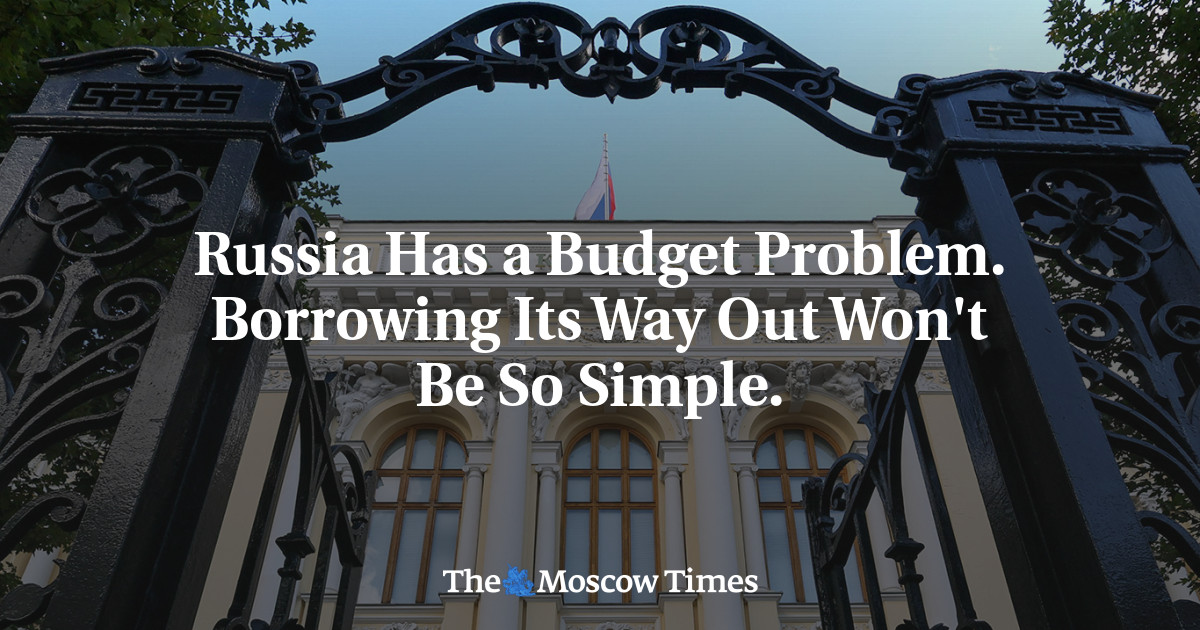
Russia's federal budget deficit reached 5.8 trillion rubles ($68.4 billion), or 2.5% of GDP, in the first eight months of 2026 — already surpassing the 3.8 trillion rubles ($44.8 billion) planned for the entire year.
President Vladimir Putin has downplayed the shortfall, pointing out that Russia's government debt, at roughly 19% of GDP, remains among the lowest in the world — far below levels in major economies like China, the U.S., France and Britain. That low ratio would, in theory, give Moscow room to borrow more.
Why borrowing is expensive
In practice, high interest rates, sanctions and a shallow domestic investor base make that option costly. Yields on 10-year Russian government bonds have hovered between 14% and 16% through 2025 and 2026, compared with an average of about 4.3% across G7 economies. Sanctions have largely cut foreign investors out of the market, leaving the government dependent on domestic buyers, chiefly major banks.
Debt servicing costs are projected to approach 4 trillion rubles ($47.2 billion) this year — roughly a tenth of federal spending, more than the combined education and healthcare budgets. By contrast, Germany, whose debt-to-GDP ratio is about three times Russia's, spends only around 6% of its federal budget on debt servicing.
Finance Minister Anton Siluanov has warned that expanding debt further would crowd out other spending priorities.
Tax hikes and spending cuts instead
With fiscal reserves depleted by years of war spending, the government's 2027 budget plans include about 2 trillion rubles ($23.6 billion) in spending cuts alongside tax increases — including raising taxes on property-sale and deposit interest income to as much as 22%, imposing a 22% VAT on foreign online purchases, and a new customs fee on small parcels.
Analysts warn these measures risk further weakening business activity and investment. Fixed investment already fell 9.9% year-on-year in the first half of 2026. Experts also caution the changes could push up consumer prices, with online marketplace costs potentially rising 5% to 10%.
/nginx/o/2023/12/20/15791292t1hc8f9.jpg)