Russian Drone Attack Damages Dormition Cathedral of Kyiv Pechersk Lavra
On June 15, 2026, a Russian drone strike set fire to the Dormition Cathedral of the Kyiv Pechersk Lavra, causing significant damage. UNESCO and international leaders condemned the attack.
Attack and Damage
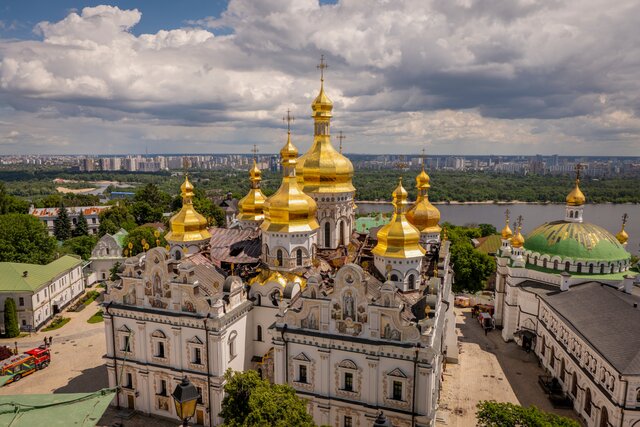
On June 15, 2026, the Dormition Cathedral of the Kyiv Pechersk Lavra, a UNESCO World Heritage site, was damaged by a Russian drone attack that sparked a fire. The fire was extinguished by 8:35 a.m. local time, but the cathedral's roof and domes were damaged. Reserve director Maksym Ostapenko reported "very serious damage" to several national landmarks. Ukraine's Culture Ministry stated that the Treasury of the National Museum of Ukrainian History, the Museum of Books and Book Printing, the National Historical Library, and other institutions were also affected.
The worst damage was to the Dormition Cathedral, the main church of the monastery. Ukrainian media reported severe damage to the iconostasis, murals, and frescoes. A direct hit on the Stefanivsky side chapel caused a powerful fire. Icons and relics were evacuated safely thanks to coordinated efforts by the monastery's brotherhood and rescue crews.
The Ivan Kushchnyk Tower, a fortification built at the turn of the 17th and 18th centuries, was also significantly damaged, as was the adjacent Mystetskyi Arsenal cultural complex, whose roof caught fire.
Blame Game
Ukraine's Security Service (SBU) said a Russian drone struck the cathedral around 1:50 a.m. and published photos of debris indicating components manufactured at the Alabuga special economic zone in Tatarstan. Russia's Defense Ministry claimed the fire was caused by a "malfunction" of a Ukrainian Patriot missile, alleging that the "Kyiv regime" was supplied with "expired missiles."
History of the Dormition Cathedral
The Kyiv Pechersk Lavra dates to the 11th century. The Dormition Cathedral was laid in 1073 and completed by 1078. Its builders were likely foreigners from Constantinople. The cathedral's dome exceeds that of St. Sophia Cathedral in volume. Its original medieval plan—a cross inscribed in a square with a central dome—became a model for many later churches.
The cathedral has been destroyed and rebuilt multiple times: an earthquake in 1230, the Mongol invasion in 1240, a fire in 1718, Bolshevik artillery in 1918, and a devastating explosion in November 1941 during the German occupation. It was restored between 1998 and 2000 and reconsecrated on August 24, 2000. In January 2026, the Lavra had already been damaged when the entrance to the Far Caves and the Church of St. Anna's Conception were struck.
International Reactions
UNESCO condemned the attack. Ukrainian President Volodymyr Zelensky called on G7 countries not to ignore it. French President Emmanuel Macron said the strike was another reason for the G7 to do everything possible for a ceasefire. Ukrainian Foreign Minister Andrii Sybiha said Ukraine would launch procedures within UNESCO to secure a response to what he called "state barbarism."
Other Cultural Sites Affected
The National Dovzhenko Film Studio suffered damage, with its costume workshop and the largest costume collection in Ukraine destroyed. In Dnipro, the House of Organ and Chamber Music was damaged. According to the Culture Ministry, 1,913 cultural heritage sites have been damaged or destroyed since the start of the full-scale invasion.