Foreign Workers in Latvia: From Truck Drivers to Students, With Very Different Work Models
Data from Latvia's Central Statistical Bureau, the State Audit Office and a Saeima inquiry commission show that foreign labour in Latvia is highly varied, yet no institution knows exactly how many foreigners actually work there.
Foreign labour in Latvia covers very different groups, and the authorities lack a precise picture of how many foreigners actually work in the country. This follows from a demographic review published in October by the Central Statistical Bureau (CSP), an audit by the State Audit Office and a report by a Saeima parliamentary inquiry commission.
Population and migration
At the start of 2026, Latvia had 1,845,096 residents, 15,469 fewer than a year earlier. In 2025, 11,931 children were born and 26,109 people died. In total, 13,826 people arrived and 15,117 left, so the migration balance was negative. The share of returning emigrants among arrivals fell from almost 68% in 2024 to 55.1%, while the number of other immigrants rose from about 4.7 to 6.2 thousand.
According to the Office of Citizenship and Migration Affairs, on 1 January 2026 there were 40,109 Russian, 6,659 Ukrainian, 6,145 Indian and 5,091 Uzbek citizens registered in Latvia. Uzbek citizens were granted about 7,200 employment rights in 2025, and Indian citizens around 3,000.
Drivers, builders, students
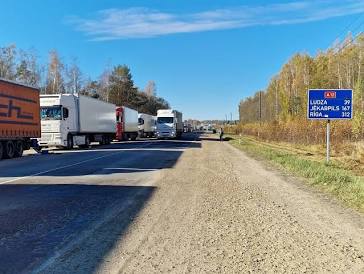
State Audit Office data show that from early 2024 to mid-2025 about 40% of work permits issued to third-country nationals went to truck and tractor-unit drivers, compared with 14% for highly skilled professions. In August, the Lithuanian transport group Girteka announced it was moving part of its transport operations to Latvia and Romania.
In construction, another model is common: a company from another EU state sends its employees to Latvia. In 2025, 4,851 posted workers were reported, including 1,863 third-country nationals, 63% of whom worked in construction. The State Audit Office warns that this may reduce tax revenue.
In the 2025/2026 academic year, 11.9 thousand mobile students studied at Latvian universities, 7.5% more than a year earlier. Of 8,260 registered food delivery couriers, 48% were third-country nationals.
Gaps in records
In 2025, third-country nationals were granted 22,917 employment rights, while on 1 January 2026 about 15.7 thousand people in Latvia held valid rights with work as the purpose of entry. In the State Audit Office sample, in 18% of cases no employment relationship was registered after a permit was issued, and in 61% of cases where employment had ended, the permit was not cancelled within a month.