Ukraine Says It Destroyed a Key Railroad Bridge Linking Crimea to Occupied Territory as Fuel Shortages and Blackouts Grip the Peninsula
Ukrainian forces claim to have completely destroyed the railroad bridge over the North Crimean Canal, one of three rail links between Crimea and the mainland, while drone strikes caused a major fire at a power plant in Kerch, leading to widespread blackouts and worsening fuel crisis.
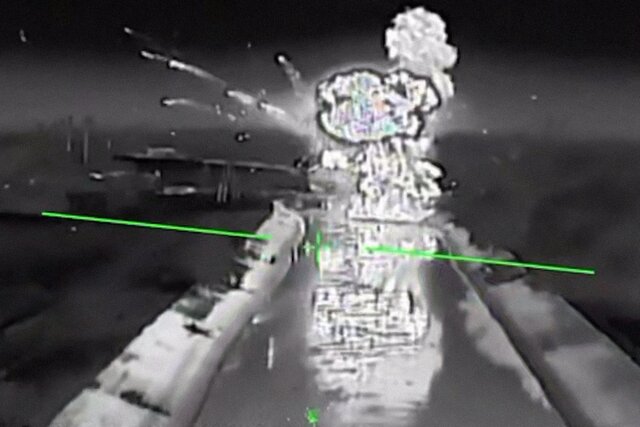
Ukraine’s Special Operations Forces announced that they have destroyed the railroad bridge spanning the North Crimean Canal, which connects the occupied Crimean peninsula to the Russian-controlled part of Ukraine’s Kherson region. They released footage of the strike, but there has been no independent confirmation, and Russian officials have not commented. The bridge is one of only three railroad connections between Crimea and the mainland, alongside the Kerch Bridge and the Chonhar Bridge.
Overnight, Ukrainian forces also launched a massive drone attack that targeted, among other sites, a thermal power plant in Kerch. A large fire broke out, sending smoke visible for dozens of kilometers. The resulting power outages affected the entire peninsula. Russian-appointed authorities in Crimea attributed the blackouts to “technical faults in the electrical grid.” Since Sunday, some parts of Crimea have had electricity only for a few hours a day on a rotating schedule, after previous Ukrainian strikes on the region’s power infrastructure.
The situation for residents of Crimea has been deteriorating sharply over recent weeks as Ukraine has intensified drone strikes on what it calls the “near rear” — a zone several dozen kilometers from the front line. Roads running through this zone connect the occupied peninsula to Russia via occupied parts of Kherson and Donetsk regions. Drones have been targeting trucks delivering goods, especially fuel, to Crimea.
For several weeks, fuel in Crimea has been sold under a rationing system. Since June 21, gasoline sales at filling stations have been completely halted, with only government services allowed to purchase it. On June 23, Crimean authorities announced they would allow up to 200 liters of fuel to be brought across the Kerch Bridge per passenger vehicle — double the previous limit of 100 liters, which had been imposed out of fear that Ukrainian strikes on vehicles could cause explosions and damage the bridge.
Russian authorities are also shifting responsibility for tourists’ fuel supplies onto hotel operators. According to Fontanka, citing Georgy Mokhov, vice president of the Russian Union of the Travel Industry, hotels in Feodosia, Yevpatoria, and Yalta have been instructed to inform new guests that they need to bring reserve fuel in canisters and arrange for its safe storage.
The Ukrainian Defense Ministry said the previous day that it was “closing the beach season in Crimea,” noting that in just the past few days, strikes had hit an oil depot, gas compressor stations, radar stations, and air defense systems on the peninsula. “The forecast for tourists is unfavorable,” the ministry stated.
Ukraine’s military leadership has promised to intensify attacks. National Guard commander Oleksandr Pivnenko said: “We will increase the number of our pilots at operational depth and destroy the enemy’s logistics far more aggressively… We will cut off the enemy’s logistics so thoroughly that it will be very hard for them.”
Amid the worsening situation in Crimea, Ukraine’s Permanent Representative to the United Nations, Andriy Melnyk, signaled that Ukraine may reconsider its approach to ending the fighting. He called on the UN Security Council to adopt a resolution urging an earliest possible ceasefire along the front line, noting that Ukraine already views this as a compromise and is prepared to “modify its approaches” in the near future. “You will never be able to hold the occupied territories. Never. Get out of Ukraine as fast as you can,” he said, addressing Russia.
/nginx/o/2026/10/17/17979351t1h875b.jpg)