Neanderthal wooden tools in Spain found preserved as molds in stone
Spanish archaeologists have cataloged 597 wooden remains at the Abric Romaní rock shelter near Barcelona, preserved as hollow molds in a limestone-like crust. Thirteen were made or modified by Neanderthals, including spears and a club unlike any found before.
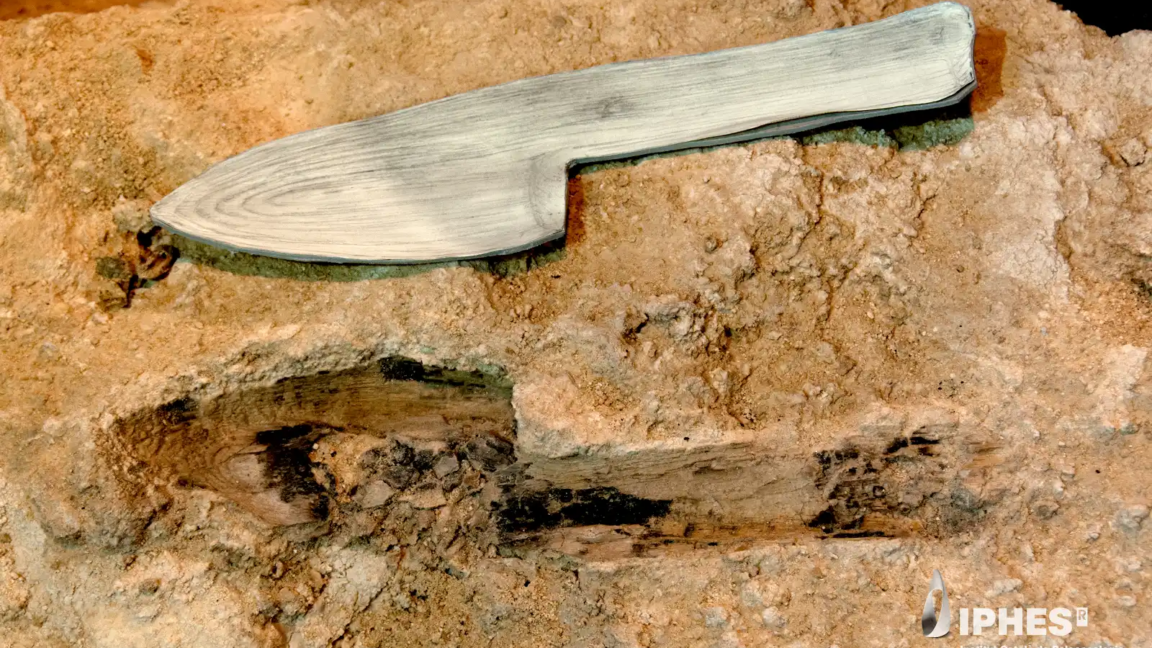
A team of archaeologists in Spain has described Neanderthal wooden objects that survived as hollow molds in stone. The study, published in the journal Science Advances, is based on excavations at the Abric Romaní rock shelter in Capellades, west of Barcelona. The finds date from 62,000 to 40,000 years ago and offer a rare view of Stone Age woodworking, since wood normally rots quickly.
The shelter lies at the foot of a travertine cliff. Travertine is a limestone formed from calcium-rich spring water. As the water dripped across the shelter floor, it coated whatever lay there in a calcium carbonate crust. Inside it the wood slowly decomposed, leaving cavities that reproduce the original shapes, sometimes down to the outlines of wood cells visible under a microscope.
What was found
In total, 597 wooden remains were cataloged. Most are natural trunks, fallen branches and firewood, mainly Scots pine. Only 13 objects were made or modified by Neanderthals. They include spears, digging sticks, bark trays, parts of shelters and a club. Four shallow trays of juniper bark were found near hearths, the largest measuring 55 by 20 centimeters. A branchless pole more than five meters long may have served as a windbreak or simple hut.
The best-preserved spear is 2.45 meters long. The club was carved from a single piece of wood, with a 16-centimeter handle and a pointed head about 14 centimeters tall. M. Gema Chacón of the Catalan Institute of Human Paleoecology and Social Evolution (IPHES-CERCA), a co-author, says nothing quite like it has turned up elsewhere. The only earlier object hypothesized to be a club, roughly 400,000 years old, comes from Zambia.
Why it matters
Most other ancient wooden artifacts are weapons. These finds come from a place where Neanderthals lived, slept and cooked over some 20,000 years. According to Chacón, the choice of materials points to planning: tools were made from fresh wood, while firewood was dry. She also suggests that similar discoveries may have been missed elsewhere because of limited time and funding.