Four 'priceless' Renaissance paintings stolen from Sicilian museum
Four Renaissance-era paintings by Antonello da Messina have been stolen from a museum in Messina, Sicily, in what Italy's culture minister called a loss of extraordinary value. Police are investigating how thieves bypassed the alarm system.
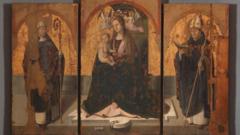
Italy's culture minister Alessandro Giuli has confirmed that four Renaissance paintings of "extraordinary value" were stolen from the Regional Interdisciplinary Museum in Messina, Sicily. The stolen works include three panels from the so-called Polyptych of San Gregorio, along with a double-sided panel depicting the Madonna with Child and Christ in Pietà, all attributed to painter Antonello da Messina.
The theft is believed to have taken place on Saturday night. Police are now investigating how the thieves managed to enter the museum without setting off its alarm system, and who might be responsible. The incident is the latest in a series of museum thefts across Europe that have seen a growing number of priceless artworks vanish from public display.
According to Italian news agency Ansa, investigators' initial theory is that the paintings were stolen to order for the black market. The Madonna and Christ in Pietà panel was taken directly from inside a secure display case, while all four works were painted on wooden panels, meaning they could not simply be rolled up for easy removal.
Museum director calls it a great loss
Museum director Marisa Mercurio said the theft is thought to have occurred at around 21:50 local time on Saturday. Speaking to Ansa, she said she was "shocked" by the incident, describing it as "a great loss for the museum, for the city, the community and the art world".
Antonello da Messina was a 15th-century painter born and raised in Sicily who went on to become one of the masters of the early Renaissance. His Polyptych of San Gregorio, painted in 1473, depicts the Virgin Mary holding the infant Jesus Christ, flanked by St Gregory, St Benedict and several angels. Five panels of the work are known to survive, and it was originally commissioned for the monastery of Santa Maria.