Pentagon AI policy chief sells millions in AI firm Perplexity after earlier xAI windfall
Emil Michael, the senior Pentagon official overseeing military artificial-intelligence policy, sold his Perplexity shares in June after previously earning up to $24m from his investment in Elon Musk's xAI. Ethics experts warn about the appearance of conflicts of interest.
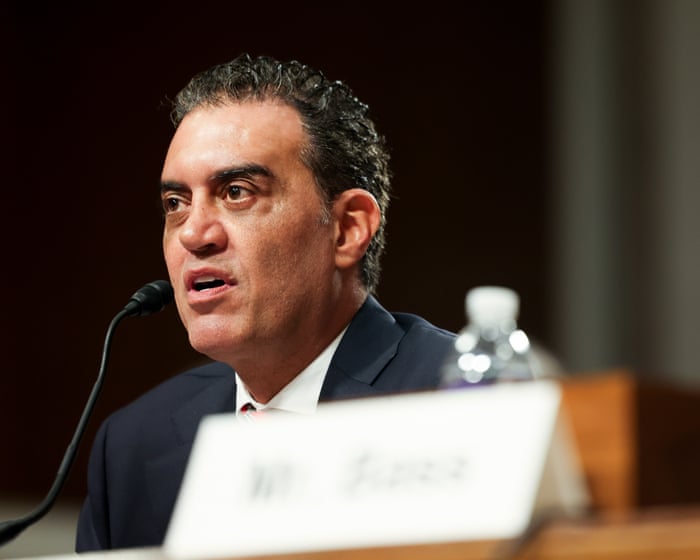
Emil Michael, the senior Pentagon official in charge of military artificial-intelligence policy, sold his shares in the AI search company Perplexity in June, according to federal financial records reviewed by the Guardian. The sale was valued at between $5m and $25m, though the documents report dollar ranges rather than exact amounts.
Earlier this year, the Guardian disclosed that Michael had already profited from his investment in Elon Musk’s xAI, with a gain of between 400% and 4,800% in January; that sale brought him as much as $24m. Perplexity, which makes an AI-powered search engine, has recently been reported to be seeking a valuation of $30bn.
The records do not show whether Michael made a profit on the Perplexity sale. The Lever reported in March that he held shares in the company. His 2025 disclosures show he received a personal loan of $250,000–$500,000 from Perplexity a year earlier at 4.57% interest, and had joined its advisory board before stepping down to enter federal service. Some of his stock was vested, some unvested, and in his ethics agreement he pledged not to profit from the unvested shares. It is unclear which shares he sold.
Perplexity announced a contract with the US General Services Administration in November last year, but records do not tie it specifically to the Pentagon. Ethics expert Richard Painter, a former White House lawyer under George W Bush, said Michael should have disposed of all his company interests before taking office. “That’s the way we would have done it back when I was working for president,” he said. A Pentagon spokesperson said Michael and other defense officials “are in full compliance with ethics laws and regulations,” adding that the department has a “rigorous, multi-layered ethics framework.” Painter acknowledged the ownership was not illegal, but said it would still raise questions because of appearances: “Most administrations would have said get out of that stock before you start that job.”
Michael's trading has not been limited to AI firms. His latest filing shows he realized gains of at least 473% from selling holdings in Brex LLC in April for at least $5m. Brex, a financial software company backed by Peter Thiel, was acquired by Capital One that month; Michael had been a consultant there. In March 2025 his Brex holdings were worth at most $750,000, so his profit could have ranged from $4.25m to $24m. Brex does not appear to do any reported work with the US government.
Michael, who was chief business officer at Uber from 2014 to 2017, has been a frequent podcast guest. A December episode of the tech podcast Sourcery that featured him was sponsored by Brex while he was still an investor. In 2014, BuzzFeedNews reported that Michael had privately floated digging up dirt on critical journalists; he said the comment, made at what he thought was an off-the-record dinner, did not reflect his views.