Nobel Physics Prize awarded to Francis Halzen for IceCube neutrino detector
The Nobel Committee in Stockholm has named Belgian-born scientist Francis Halzen, who works at the University of Wisconsin-Madison, as the 2026 physics laureate for his contribution to the IceCube neutrino observatory. The discovery allows researchers to study high-energy neutrinos from deep space.
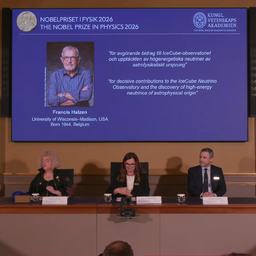
The Nobel Committee in Stockholm has named Belgian-born scientist Francis Halzen, who works at the University of Wisconsin-Madison, as the recipient of the 2026 Nobel Prize in Physics, Deutsche Welle reports.
He received the award for his decisive contribution to the operation of the IceCube neutrino observatory and for the discovery of high-energy neutrinos of astrophysical origin.
An observatory built into Antarctic ice
The IceCube observatory was constructed in Antarctica in 2011 and consists of a cubic kilometer of ice fitted with light sensors. Using this instrument, scientists can detect tiny neutrino particles produced by colossal energy releases far out in space.
According to the Nobel Committee, extremely high-energy neutrinos form under the same conditions as other types of particles, but unlike those particles, they reach us without changing direction or losing energy. This means they can serve as a source of information that cannot be obtained in any other way.
More announcements during Nobel Week
During Nobel Week in Stockholm, the laureates in chemistry and literature will be announced on October 7 and 8, while the Peace Prize winner will be named on October 9 in Oslo. On Monday, October 12, the laureate of the Sveriges Riksbank Prize in Economic Sciences in Memory of Alfred Nobel, established in 1968, will also be announced.

/nginx/o/2026/10/06/17958748t1h4491.jpg)