Meta launches Muse Code, its take on a coding agent
Meta has announced an early beta of Muse Code, a new coding agent that competes with Anthropic's Claude Code and OpenAI's Codex. The terminal-based tool is powered by the Muse Spark 1.2 model and features lower pricing than rivals.
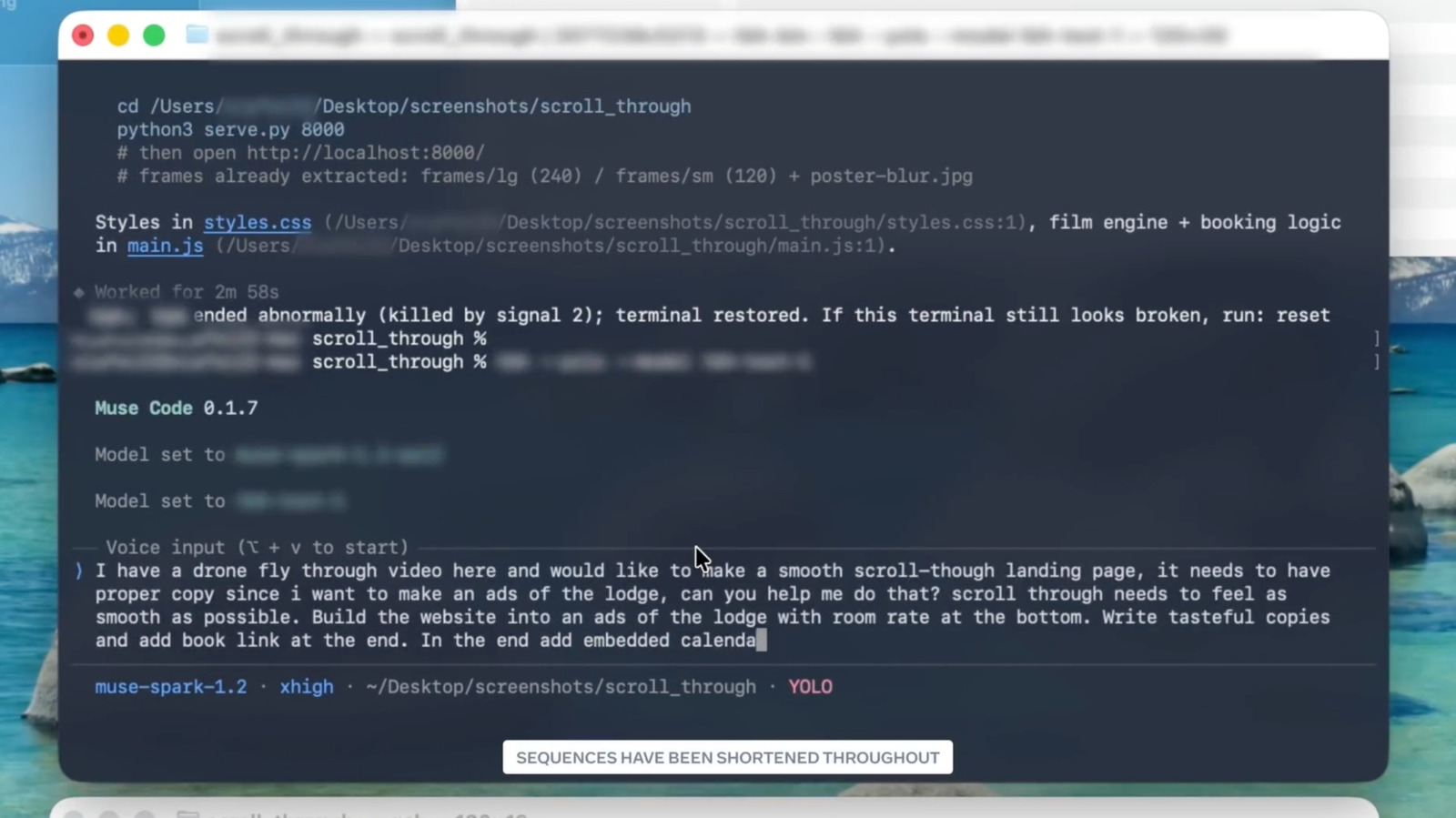
Meta has introduced an early beta of Muse Code, a new coding agent designed to go head-to-head with Anthropic's Claude Code and OpenAI's Codex. The terminal-based tool runs on Muse Spark 1.2, an updated version of Meta's AI model that brings improvements in code generation, complex debugging, codebase understanding, and end-to-end developer workflows.
Like its competitors, Muse Code can take on software engineering tasks such as writing code, planning changes, and validating results, enabling users to build functional applications through text prompts. It also supports managing multiple sub-agents and delegating tasks for greater efficiency. Meta showcased sample projects, including an interactive model of a photon sphere and a Plants vs. Zombies-style game, along with a demo video of the tool generating a webpage from an MP4 file.
Pricing appears to be a key differentiator for Meta. By default, Muse Code follows the same pay-as-you-go pricing as Muse Spark — $1.25 per million input tokens and $4.25 per million output tokens. In an interview with CNBC, Meta's Chief AI Officer Alexander Wang said the company would also offer a "contributor tier" at a significantly lower cost. According to The Wall Street Journal, that tier would require users to agree to provide feedback for improving the tool, with rates of $0.10 per million input tokens and $0.20 per million output tokens. These prices undercut Anthropic's Sonnet 5 model, which typically costs $3 per million input tokens and $15 per million output tokens. Should Muse Code perform well, the pricing difference could prompt companies to choose Meta over alternatives. The same approach has already worked for Chinese AI firms: several businesses have switched to models like DeepSeek to escape the rising costs of US-based AI tools.


