Fact check: Humans cause climate change; Europe warming faster than rest of planet
Climate scientists unanimously confirm that human activity is driving global warming, and Europe is warming faster than other continents.
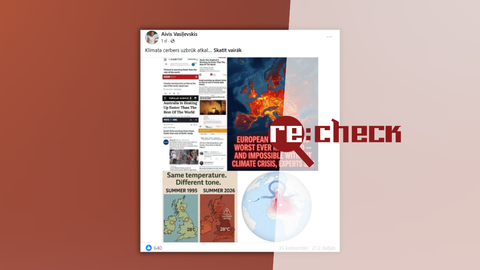
A social media post questioning human influence on climate change contains inaccurate claims, according to a fact check by TVNET. According to the world's leading climate scientists, the planet has been warming since the late 19th century industrialization, primarily due to human-caused greenhouse gas emissions. While natural climate variability exists, the temperature rise over the last 150 years has been much faster than natural factors would cause.
CO2 and plants
The claim that additional carbon dioxide (CO2) is beneficial for plants is a half-truth. Although CO2 concentrations have increased by about 50% since the mid-19th century, its effect on plants is not straightforward. As David Desmaré from the Massachusetts Institute of Technology explains, extra CO2 only promotes plant growth if there is sufficient water and soil nutrients. However, climate change increases the risk of extreme drought and reduces soil nutrients, especially nitrogen. Moreover, higher CO2 significantly reduces the nutritional value of crops, including proteins, minerals, and B vitamins.
Europe warming faster
The assertion that Europe is not warming faster than the rest of the planet is false. Compared to the average temperature from 1850 to 1900, the global average temperature has risen by 1.4°C, while in Europe the increase is 2.5°C. This is due to several factors: lower air pollution, which reflects sunlight back into space; reduced snow cover, which reflects light; land areas warming more than oceans; and atmospheric circulation patterns favorable to heat over Europe. Some regions like Finland and Canada have warmed even more, while Uruguay, Argentina, and Chile have warmed less.
Extreme weather
Contrary to claims, the frequency and intensity of extreme weather events are increasing. NASA data show that since 2020, the frequency of droughts and floods has increased significantly — in 2024, it was double the average for 2003–2020. Floods have become more common in many countries and are expected to increase further. While the frequency of hurricanes may decrease, they are becoming more intense and widespread. The frequency and intensity of prolonged droughts have risen sharply in the last 40 years, and heatwaves combined with extreme drought have become 1.8–3.7 times more frequent since 1981. Sea level rise is also accelerating — currently about 4.5 mm per year, much higher than the 20th-century average.