EU floats vague "associate membership" for Canada as Merz's troubles deepen in Germany
European Commission president Ursula von der Leyen has proposed Canada become the EU's first "associate member," despite no such status existing in the bloc's treaties. Meanwhile German chancellor Friedrich Merz faces mounting political trouble after a string of poor election results.
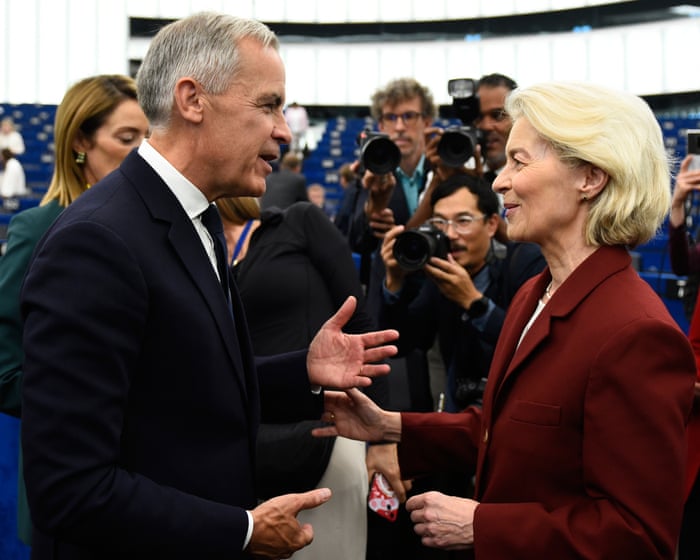
European Commission president Ursula von der Leyen recently said the EU and Canada "see the world with the same eyes," citing shared positions on artificial intelligence, climate change and the war in Ukraine. She suggested Canada should become the EU's "first associate member." Canadian prime minister Mark Carney welcomed the idea enthusiastically, speaking of an "alliance for the future" built on "deep cooperation."
The catch is that "associate membership" is not an actual status under EU treaties, and creating one would require treaty reform that member states are unwilling to pursue. Formal "association agreements" exist with countries such as Ukraine, Moldova and Georgia, but those serve as stepping stones toward full membership — an option unavailable to Canada, which is not in Europe.
For Canada, the push is driven largely by Donald Trump's tariff threats and an escalating trade war, which have pushed Ottawa to diversify its international relationships. Trump dismissed the proposal as "laughable" and threatened further tariffs. For the EU, Canada represents a stable partner rich in critical minerals and rare earths, and the enthusiasm offers a morale boost after Iceland recently rejected further EU accession talks.
Analysts suggest a more realistic arrangement might resemble the EU's relationship with Switzerland, focused on concrete cooperation in defence and programmes such as Horizon and Erasmus+, rather than single-market access. Some observers note that any new EU status for Canada is unlikely to translate into benefits for post-Brexit Britain, since Canada is seeking deep cooperation without touching single-market rules — while the UK's core problem is exclusion from that very market.
Merz under pressure
Separately, German chancellor Friedrich Merz is facing a political crisis. His CDU party recently failed to clear the 5% threshold needed to enter the state parliament in Mecklenburg-Western Pomerania, and in Berlin it was beaten by the far-left Die Linke while the far-right AfD posted a double-digit result. Merz now faces a choice between revising unpopular economic reforms or risking political irrelevance.