Nationalist parties dominate Bosnia and Herzegovina's election amid record-low turnout
Nationalist parties swept Bosnia and Herzegovina's general election across all three ethnic communities, though turnout fell to a record-low 41.5%. Serb nationalist leader Milorad Dodik, banned from holding public office, declared victory for his party.
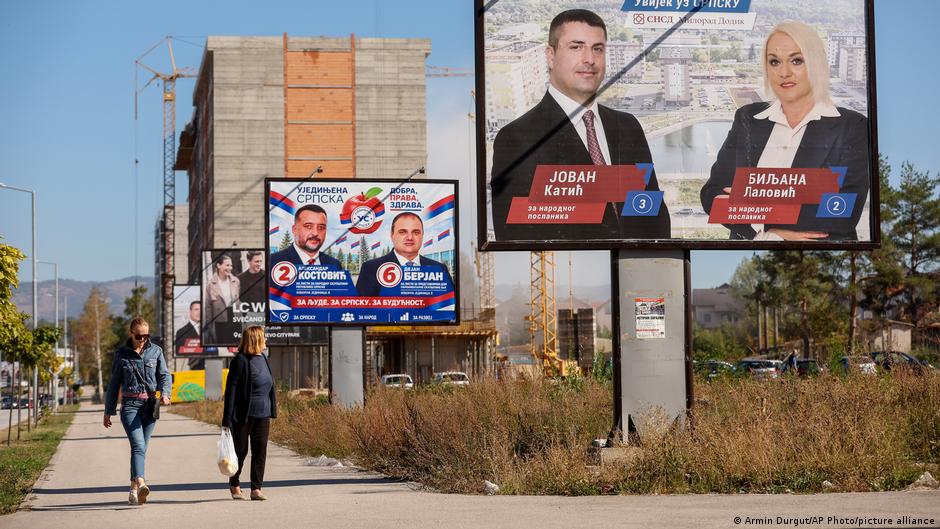
Bosnia and Herzegovina held general elections on Sunday that drew only 41.5% of the country's 3.4 million eligible voters, the lowest turnout on record and a sharp drop from 51.5% in 2022, according to the Central Election Commission after more than 90% of votes were counted.
In the race for the country's tripartite, multiethnic presidency, Serb nationalist Zeljka Cvijanovic, Bosniak moderate leftist Denis Becirovic, and Croat nationalist Darijana Filipovic emerged as winners for their respective ethnic seats. Cvijanovic had the backing of Republika Srpska's former secessionist leader Milorad Dodik, who is barred from holding public office for six years after being convicted of defying the international envoy overseeing Bosnia's peace process. Dodik declared his SNSD party's victory and its continued hold on power in Republika Srpska.
Ethnic divisions persist
Voters also elected members of the federal parliament and leadership for the country's two semi-autonomous entities, the Muslim-Croat Federation and the Serb-led Republika Srpska. While Bosnia has remained peaceful in recent years, ethnonationalist parties continue to sustain divisions even as citizens express a desire to move past wartime rhetoric.
The vote took place against a backdrop of economic decline, slow progress toward EU accession, and persistent political gridlock caused by dominant ethnic parties blocking decisions by the weak central government.
In Republika Srpska, Dodik remained the dominant figure despite not appearing on the ballot himself. His chosen candidate, Savo Minic, won the entity's presidency decisively, and the SNSD increased its parliamentary share to 39%, up from 34.6% in 2022. Dodik, who recently met Russian President Vladimir Putin, favors closer ties with Serbia and Russia and has pushed for Republika Srpska's secession from Bosnia.
In the Muslim-Croat Federation, Bosniak parties, led by the SDA, campaigned on preserving a unified state against Serb separatism, while Croat voters largely backed their own ethnic parties. Becirovic pledged to continue pursuing EU and NATO membership, though the actual start of accession talks depends on Bosnia implementing reforms, including stronger judicial oversight and anti-corruption legislation.
/nginx/o/2026/10/02/17950846t1h036c.jpg)